


Description
The Mackie CFX16 mixer is primarily designed for use in small to medium-sized live sound systems. Despite its compact size, it’s still spacious enough to not feel uncomfortable working with, and it lives up to what we’ve come to expect from Mackie, combining a familiar look and feel with a practical technical specification that offers the best performance possible.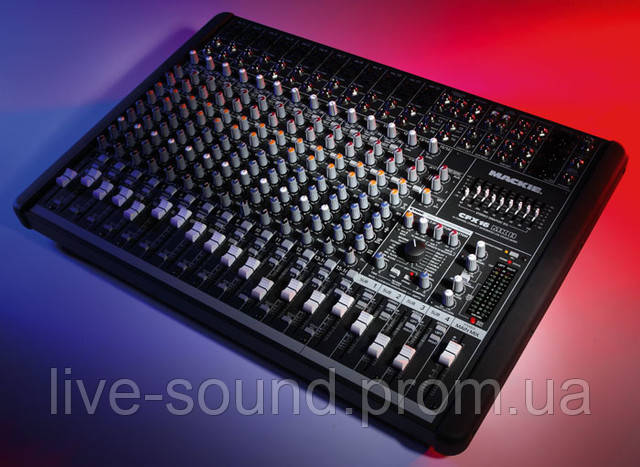
Digital effects, mainly reverbs and delays, are built-in, and although they are based on presets, two live parameter knobs can be used to fine-tune them. The CFX mixers come with a 12-volt BNC jack for adding a gooseneck lamp, which is necessary in many darker locations, and there is a nine-band graphic EQ on the main output.
The CFX is all metal with stylish protective end cheeks, and Mackie has placed all connectors on the top panel for easy access. Power is supplied from the mains, not from some awkward external adapter. Effect loops are provided for the mono input channels and the main stereo output, but not for the buses. The mono channel setup begins with the usual gain and bass shelf controls (18 dB/octave at 100 Hz), but then deviates from the traditional by placing four aux controls above the EQ section. The three-band equalizer with a configurable midrange has a tuning range all the way up to 100 Hz. Frequency slices at the usual 80 Hz and 10 kHz monitor the edges of the spectrum, all bands have a gain range of +/- 15 dB.
The bottom of the channel contains the usual pan and fader controls, accompanied by a mute button and a pair of assignment buttons for two sets of buses (1/2 and 3/4). The Solo button is located next to the lower end of the fader, and there is a large flashing Solo indicator in the master section (but not on the channel itself). In accordance with the compact size of the mixer, the channel faders are 60 mm long, not 100 mm, but this does not affect practicality.
For stereo line channels, the aux setup is the same, but the equalizer is replaced by a fixed four-band section, not a three-band section with an adjustable midrange, and there is no bass switch. On the three-band equalizer, the two mid-bands operate at 3 kHz and 400 Hz. Keep in mind that this is not a four-bus plus stereo mixer – everything must go through subgroup 1/2 or 3/4. The group (sub) faders have assigned buttons to send them to the main mix, so you need to send at least one pair of faders to get the output.
The master section is relatively simple, with one master fader and a pair of output meters that also display solo levels when you press the Solo/PFL button. It’s helpful that the meters are calibrated from 0VU to 0dBu so you know exactly what level you’re getting. Below the meters is a large red flashing “Rude Solo” LED and above the meters is the global phantom power button. There’s no bypass button for the nine-band graphic equalizer, but at least it has center faders.
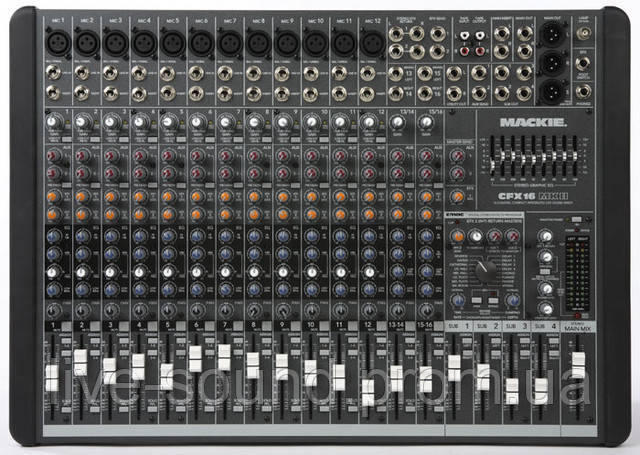
Each of the four aux faders has assigned Left and Right buttons to direct it into the main mix. The main aux level controls are also located in this section. A single headphone amplifier that provides sufficient volume for normal headphones is supplied from the main output or from the solo channel when the Solo/PFL button is pressed. However, there is no way to switch the monitoring from headphones to the Aux preamps so that you can check the feedback mix. In addition, there are no solo buttons on the aux sends or returns, so you can’t use them as a workaround.The 32-bit effects section is powered by an EFX2 control, and there’s a master effects input control with a clip LED to ensure that the effects section doesn’t get too overloaded. An output level control adjusts the amount of output effects sent to the main stereo mix, with two additional controls allowing for independent mixing of the Aux 1 and Aux 2 outputs with a foldback for those who like to hear reverb in their monitors. A large knob toggles between 16 effect types, which, in addition to Chorus, Flange, and Phaser, are reverbs and delays, including strobe and reverb options. Two buttons control the effect, one to bypass it and the other to increase the stereo width of the stereo effects (rather than the Delay or Phaser, which are monophonic), while two rotary knobs allow you to adjust the effect time and damping. In fact, these labels only apply to reverbs – for Delay effects, the Damping control becomes a feedback control, and for Modulation effects, it sets the modulation depth, while the Time control sets the modulation frequency. A footswitch socket is available to bypass the speakerphone effect.
 .
.
The reverbs offer a good selection of playback, hall and small room, and even spring reverbs. Compared to some other mixers that offer built-in effects, the quality of CFX’s offerings is very good, with many useful options. The sound quality is everything you’d expect from Mackie, and the useful effects section is a big bonus! The nine bands of graphic EQ may not be enough to surgically reduce feedback, but it does a good job of dealing with the worst of typical live room anomalies and is a welcome addition.All small mixers have to be a compromise, otherwise the size and rental price would get out of control. Considering the price and quality on offer here, Mackie has done a good job of offering the small band all the essentials in a live mixer, although those with more complex monitoring needs may need to look elsewhere. Consider, for example, the Behringer X32 or the Behringer WING. However, for pubs and small clubs, it will be just right! . . . . .
Technical characteristics:
.
.
.
.
Additional information
| Unit |
|---|


